



Trump 2.0: Americans Aren’t Buying It (Mostly Because They Can’t Afford it)
03/16/2026
One year after President Donald Trump returned to office promising, “The American dream will soon be back and thriving like never before,” the voters who will be the first to render judgment on that claim are not happy.
We spoke to thousands of voters who live in the battlegrounds – the swing districts and states that control the balance of power in the House and Senate. What we heard, overwhelmingly, was anxiety.
Many of these voters are focused on fundamental issues of economic survival: how to afford food, shelter, and utility bills. Many are worried about the disappearing safety net. A significant portion of the electorate is also either still concerned about unlawful immigration or newly concerned about ICE’s new aggressive tactics. But economic fears dominated the conversation.
These decidedly pessimistic views from voters across the political spectrum are animating an apparent fracture among Republicans’ key constituencies in these battlegrounds. Trump’s Republican allies in Congress have supported his leadership in near lockstep over the past year. But their constituents, including their base, have lost faith and patience in Trump’s economic vision and performance.
Using powerful voter models, we can look at the voters Republicans rely on to secure their majority: their solid base, voters who leaned Republican, and those without reliable partisan loyalties (unknowns). When we compare what we hear now from these voters in swing districts and states with what we heard a year ago, at the administration’s 100-day mark, the trend is stark.
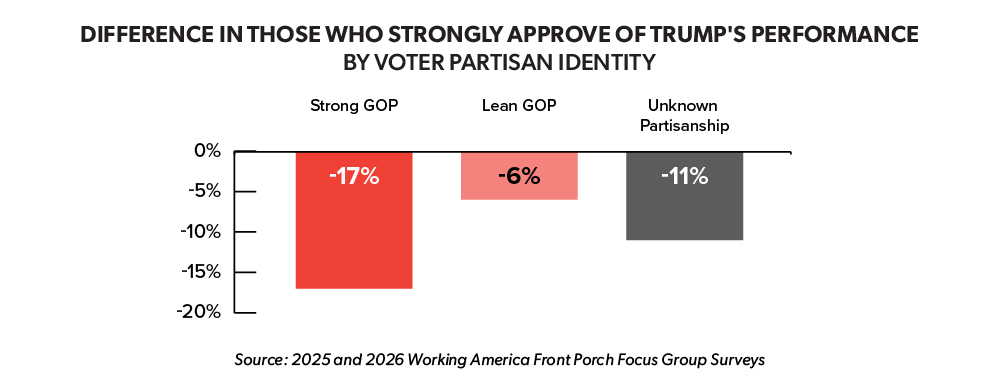
We asked slightly different questions in 2025 (approval on the economy) and 2026 (approval overall), but for a president who swept to office on economic discontent with his predecessor, this shift in sentiment is undeniably meaningful. At the same time, Democratic voters have become galvanized in their opposition. The voters in these battlegrounds are rejecting Republicans’ governing policies.
These are not aberrant moments of voter discontent. They are long-term trends. Because we engage voters in open and expansive conversations, we are able to delve deeper into what they are thinking and feeling beyond just yes/no answers. And because we talk to the same voters, and voters in the same communities, over years, we have a clear view into how opinions have shifted over time. (Notably, we completed this survey shortly before the U.S. launched a large-scale attack on Iran. Early public polling shows 1 out of 4 Republicans and almost 7 out of 10 Independents disapprove of the invasion, and oil prices surged quickly, suggesting that there would be little “rally around the president” effect in the immediate short term.)
Bottom line – we’ve seen these vibes before. In many ways, voters’ take on the economy, and the party in control of it, mirrors the skepticism we saw in early 2024 toward then-President Joe Biden’s economy. Given how strongly voters ultimately rejected Democrats’ leadership on the economy that fall, voters’ unease with Republican control now could mean an upheaval in these swing districts and states this fall.